A good chocolate tart doesn't require professional baking skills, but it does require a recipe that explains each step clearly. Recipes vary in their choice of chocolate, crust, and filling, which can make it difficult to know where to start. This guide covers the ingredients, techniques, and baking steps needed to make a rich, smooth chocolate tart at home, including what to look for at each stage and how to avoid common mistakes.Table of Contents
Your Journey into Chocolate Cooking Starts Here
A useful chocolate cooking book does more than collect desserts. It establishes a consistent approach to ingredients, instructions, and learning. That consistency matters when a baker wants to understand a disappointing result rather than abandon the recipe.
The audience is substantial. IndexBox’s global chocolate-market overview puts worldwide consumption of chocolate and other cocoa-containing foods at approximately 4.7 million metric tons in 2024, with the United States accounting for roughly 671,000 metric tons. That broad appetite leaves plenty of room for different cookbook philosophies, from straightforward family baking to detailed confectionery instruction.

Choose a purpose before choosing a title
Consider the difference between a baker who wants dependable cookies and someone determined to make molded chocolates. Both enjoy chocolate, but they need different instruction. A book can serve either reader well without being suitable for the other.
The strongest purchasing decision begins with a description of the cooking experience the reader wants:
-
Everyday satisfaction: Favor recipes that fit ordinary cooking habits, rather than projects that demand unusual preparation.
-
Deliberate practice: Seek explanations, troubleshooting, and opportunities to repeat a technique.
-
Dietary confidence: Prioritize recipes designed around the relevant restrictions, not casual substitution notes.
-
Creative exploration: Look for thoughtful variations that explain what changes and what should remain consistent.
A tempting cover doesn't answer those questions. Sample pages, recipe introductions, and the contents list offer a better basis for judgment.
A digital cookbook deserves the same scrutiny as a printed volume. Its value depends on the quality of its instruction, not merely the convenience of downloading it. The right choice should make the next cooking decision clearer: which recipe suits the occasion, what preparation it requires, and what a successful result should resemble.
That is the useful standard. A cookbook should earn its place through repeated use, not through the ambition of its photography.
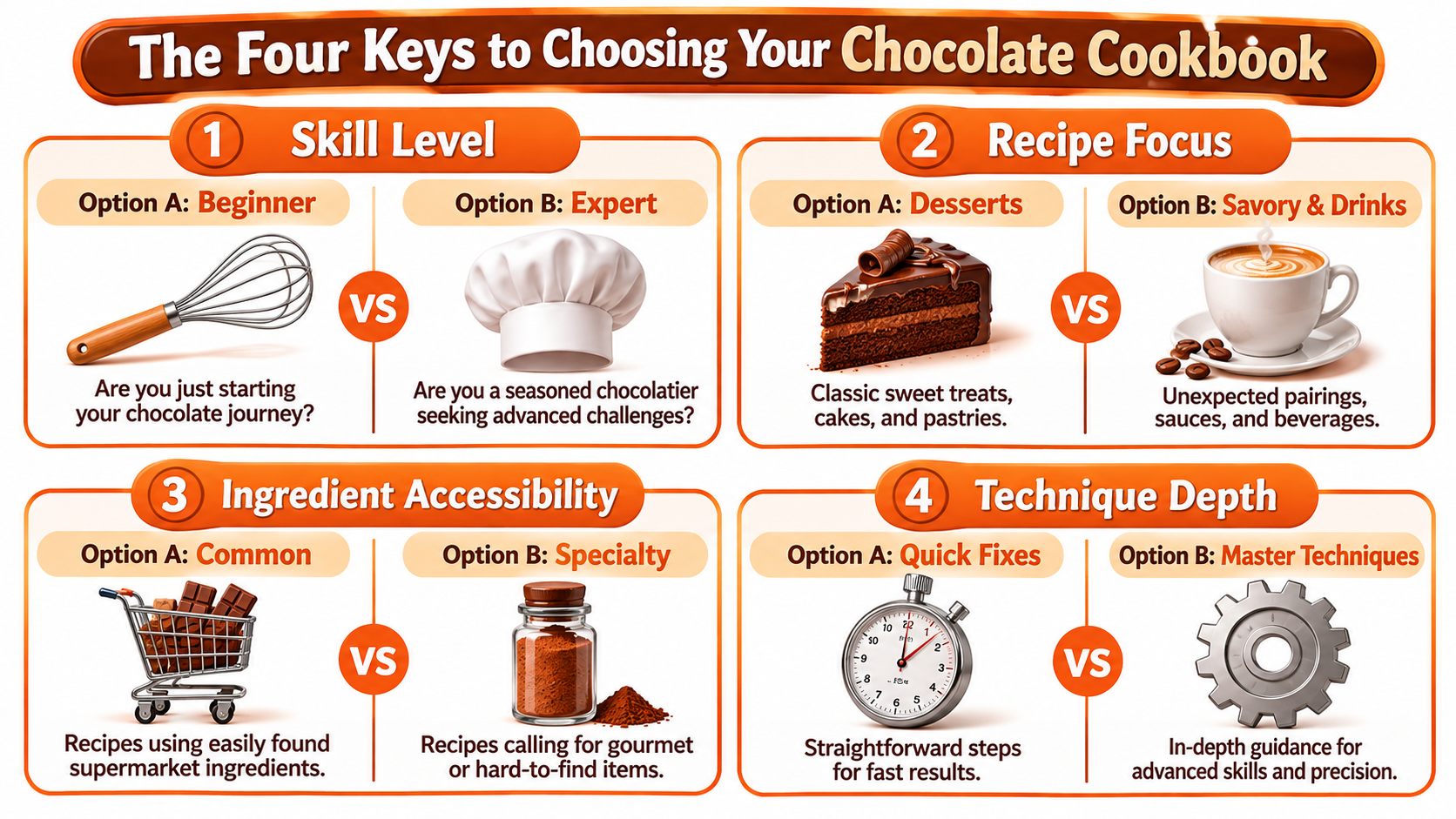
The Four Keys to Choosing Your Chocolate Cookbook
The most useful selection criteria concern what a book teaches, what it values, how it handles ingredients, and which culinary traditions it explores. These are also sensible criteria for choosing cookbooks for regular home use: the reader’s actual habits should matter more than the cover’s promise.
Technical depth should match the intended effort
Does the book explain enough for the cook to understand and correct a disappointing result?
Technical depth isn't the same as difficulty. A clearly explained cake can teach more than an elaborate dessert whose instructions assume prior knowledge.
Inspect a sample method for descriptions of appearance, texture, and readiness. Instructions should help the cook recognize progress, not merely move from one action to another. Troubleshooting deserves particular attention when the intended purchase is a learning resource.
For occasional baking, concise methods may be preferable. For skill development, choose a book that explains decisions and identifies common mistakes. Neither approach is superior; the mismatch causes the frustration.
Recipe philosophy should reflect real priorities
Does the book treat the reader’s priorities as central requirements or optional adjustments?
A classic indulgence collection should be judged on its ability to deliver the desserts it promises. A healthier-indulgence collection needs a different standard: clear explanations of what its adaptations are intended to achieve.
The same applies to plant-based and allergen-aware baking. A reader who needs dairy-free recipes shouldn't have to redesign a dairy-based collection. Look for clearly identified recipes developed for that requirement, with explanations of structure, moisture, and setting where relevant.
Avoid treating labels such as “healthy” or “allergy-friendly” as sufficient descriptions. The useful details concern ingredients, recipe design, and the limits of any suggested alternatives. A book should state its approach plainly enough that the buyer can judge whether it matches the household’s needs.
Ingredient guidance should remove guesswork
Does every ingredient specification explain a decision that could affect the result?
Cocoa is an excellent test. King Arthur Baking’s explanation of cocoa types distinguishes acidic natural cocoa, which reacts with baking soda, from alkalized Dutch-process cocoa, which generally pairs best with baking powder. The wrong choice can change both rise and flavor.
A useful cookbook names the required cocoa rather than leaving “cocoa powder” unexplained. Where either type works, it should say so. Where substitution requires reformulating the recipe, it shouldn't imply that changing the cocoa alone is enough.
Ingredient accessibility also deserves attention. A book can call for specialty chocolate, but it should make that requirement visible before purchase. Clear specifications are more useful than vague assurances that ingredients are easy to find.
Cultural focus should offer depth rather than decoration
Does the book explain a culinary tradition, or merely borrow its dessert names?
A reader drawn to European pastry may prefer a focused treatment of cakes, confectionery, and regional desserts. Someone interested in a wider range of chocolate cooking may prefer a collection that gives beverages, sauces, and other preparations meaningful space.
Judge cultural focus through the introductions and recipe notes. Look for explanations of the intended result, ingredient choices, and adaptations. A regional label alone doesn't establish depth.
The recommendation is straightforward: choose a focused book when a particular tradition motivates the cooking. Choose a broader collection when variety matters more than specialization. Neither needs to claim authority over every possible use of chocolate.
Find the Right Chocolate Guide for Your Kitchen
Start with the limitation most likely to prevent regular use. That might be an ingredient restriction, limited enthusiasm for complicated projects, or a desire for instruction beyond basic baking. Attractive extras shouldn't outweigh that requirement.
The following comparison turns those priorities into a practical shortlist. It recommends types of books rather than declaring a universal winner.
Which Chocolate Cookbook Style Is for You?
| If your situation is... | Look for a cookbook that... | Why it's a fit for you |
|---|---|---|
| Baking happens occasionally | Centers familiar desserts with clearly described results | It supports enjoyable projects without demanding an ongoing training routine |
| Pastry skills are the main interest | Organizes learning around techniques and troubleshooting | It gives practice a purpose beyond completing individual recipes |
| A household avoids dairy or animal ingredients | Builds its main recipes around those requirements | It reduces dependence on improvised recipe redesign |
| Food allergies shape purchasing decisions | Identifies ingredients clearly and addresses cross-contact | It makes the book easier to assess against household safety requirements |
| Healthier indulgence is the priority | Explains the intention and trade-offs behind adaptations | It allows the reader to judge more than a vague wellness label |
| Familiar desserts feel repetitive | Offers clearly explained variations and contrasting styles | It supports exploration without abandoning instructional clarity |
| Chocolate is only part of the interest | Includes chocolate within a broader dessert collection | It avoids an unnecessarily narrow purchase |
Set a nonnegotiable, then compare the appealing extras
A useful shortlist begins with one firm requirement. For example, a reader seeking plant-based baking should exclude unsuitable collections before comparing photography or recipe variety. A reader seeking technical instruction should give priority to explanatory sample pages over a long contents list.
This approach prevents an attractive secondary feature from deciding the purchase. A beautiful celebration cake isn't much help when most of the book conflicts with the reason for buying it.
A broader collection also deserves consideration when the reader doesn't want chocolate in every recipe. Just Cook It’s Dessert After Dark is a digital dessert cookbook that includes chocolate soufflé, a s’mores chocolate tart, and a brown butter chocolate chip cookie skillet. That makes it an option for readers comparing dessert variety with chocolate-only specialization, rather than a substitute for a dedicated technical manual.
Before settling on any title, inspect an appealing recipe and a less familiar one. The familiar recipe reveals whether the author’s preferred style matches the reader’s taste. The unfamiliar recipe reveals whether the explanations remain understandable without prior experience.
A book passes this check when both recipes seem usable for different reasons: the familiar dish looks worth repeating, and the unfamiliar dish looks possible to learn. That combination is more valuable than a contents list filled with impressive names.
Decoding Formats Measurements and Equipment
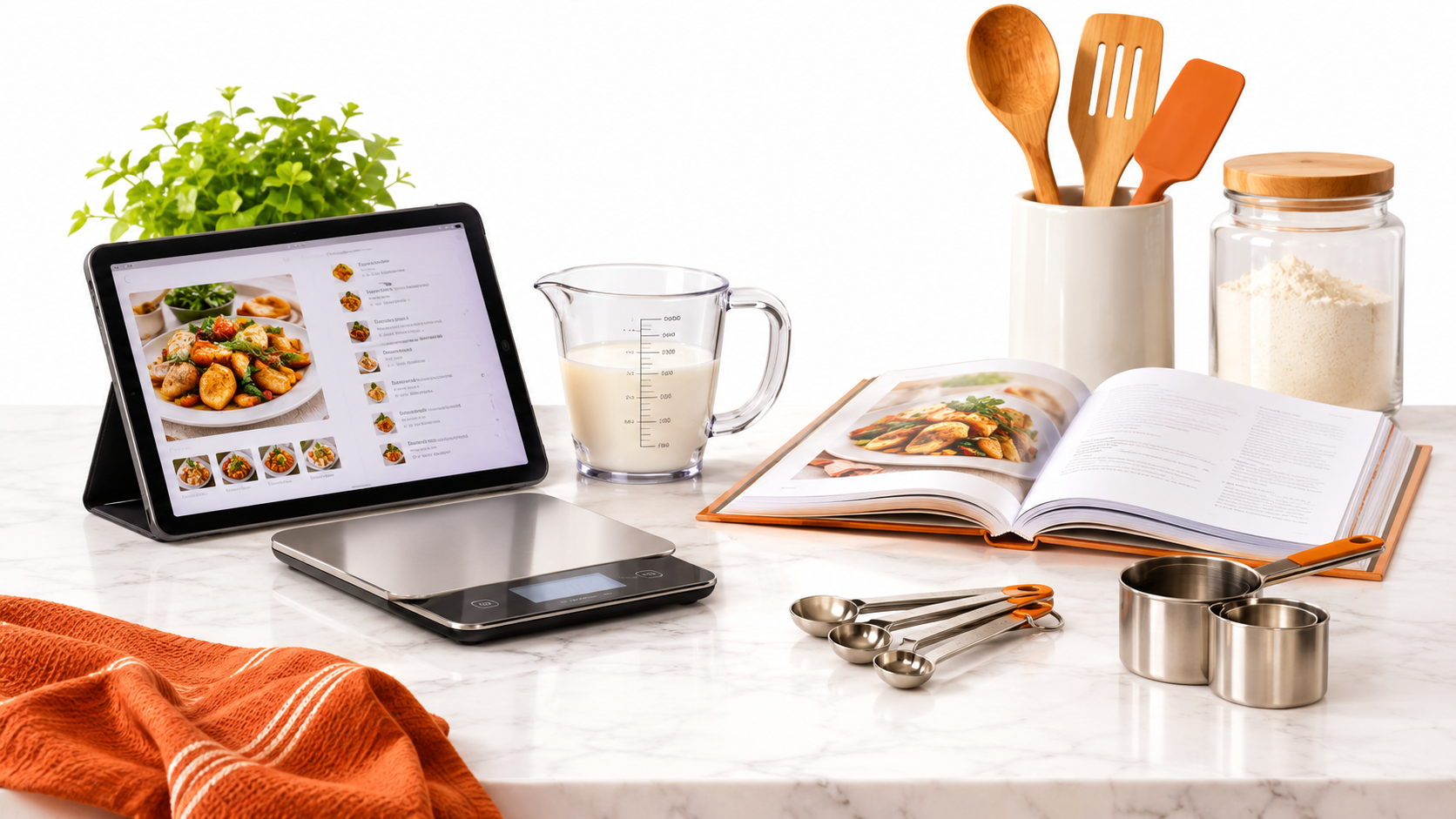
Practical compatibility deserves a separate check after the recipe style has been chosen. A promising book can still be awkward to use if its pages, measurement conventions, or equipment assumptions don't suit the kitchen.
Inspect the reading experience
For a digital purchase, check the actual file description rather than assuming every edition includes interactive features. Searchable text, embedded video, downloadable files, and future updates should be treated as separate features that require confirmation.
A sample page should remain readable on the intended device. Ingredient lists and methods should be easy to follow without constant zooming or moving between distant pages. For print, consider whether the layout leaves enough room for notes and whether the book can be positioned comfortably during cooking.
The video below offers an additional viewing option. Any cookbook’s instructions should still stand on their own rather than depend on an external video remaining available.
Audit the practical requirements
Measurement and equipment checks should happen before ingredients are purchased:
-
Prefer explicit units: Look for clearly labeled weights and volumes, with consistent conventions throughout the book.
-
Separate ingredient states: Choose instructions that distinguish quantities measured before preparation from quantities measured afterward.
-
Inventory existing tools: Compare requirements with the kitchen’s food scale, mixer, pans, thermometer, and molds.
-
Confirm workable alternatives: Where specialist equipment appears, look for an author-approved alternative rather than assuming an improvised replacement will work.
For a baking-focused purchase, weight measurements are a sensible preference because they make the author’s intended quantities explicit. Where a book supplies both weight and volume, follow a consistent system rather than switching casually between them.
Equipment lists should distinguish essential tools from presentation accessories. A recipe that depends on a particular mold should disclose that requirement clearly. Readers shouldn't discover a substantial equipment purchase halfway through preparation.
Common Questions Before You Commit
Purchasing doubts become easier to resolve when each concern is tied to a specific function. A specialist book doesn't need to justify itself through a large recipe count. It needs to provide instruction the reader will put into practice.
Does chocolate justify a dedicated book?
For readers interested in confectionery, the answer can be yes. Tempering illustrates the depth a specialist resource should provide.
King Arthur Baking’s chocolate discussion with Amy Guittard explains tempering as controlled cocoa-butter crystallization, a process distinct from melting chocolate. Heating, cooling with agitation, and maintaining a working temperature encourage stable beta crystals, which produce gloss, clean snap, and a firm set.
A useful technical book should give chocolate-specific temperatures for dark, milk, and white chocolate. It should also explain thermometer use, stirring during cooling, and a small test smear before production. A generic instruction to melt and cool doesn't provide the same guidance.
That level of detail matters for readers making coated fruit, molded bars, or other chocolate shells. Someone interested only in straightforward baked desserts may reasonably prefer a general baking collection.
Is a digital edition worth buying?
The format alone doesn't establish value. Assess what is supplied and how well it supports the intended use.
Before purchase, examine the practical terms:
-
File delivery: Confirm the supplied format and the method for accessing it.
-
Offline use: Check whether the recipes can be opened without an internet connection.
-
Access conditions: Read the seller’s stated download and access terms rather than assuming permanent availability.
-
Supplementary material: Verify any promised videos, updates, or printable pages in the product description.
A digital book is worth considering when its content suits the reader and its access arrangements suit the household. Claims about convenience shouldn't replace that check.
What if the recipes still seem too difficult?
Difficulty labels are useful only when the method supports them. A sample recipe should make preparation, active work, waiting stages, and completion cues understandable.
When an unfamiliar action appears, look for an explanation or a clearly identified supporting lesson. If the author repeatedly assumes knowledge the intended reader doesn't have, choose a more introductory resource.
For allergy-related requirements, apply a stricter standard. A dietary label doesn't settle every ingredient or cross-contact question. Readers should inspect the actual products and preparation conditions rather than treating a cookbook as a safety guarantee.
Your Next Steps to Chocolate Mastery
A useful purchase decision should end with a reason to choose one book and a reason to reject another. “The desserts look appealing” is a starting point, not a complete assessment.
The strongest choice is the book whose instructions support the way the reader intends to cook. That may mean a narrow technical reference, a dietary-focused collection, or an approachable dessert book with a substantial chocolate component.
Make the final decision concrete
Before checkout, complete a short buying brief:
-
Purpose statement: Name the result the book should help achieve, such as learning confectionery or expanding a household’s dessert rotation.
-
Evidence check: Identify the sample pages or product details that support that purpose.
-
Exclusion reason: Record the feature that would make another book unsuitable, even if its photographs are appealing.
-
First project: Select an initial recipe that fits the available ingredients, equipment, and attention.
This final step keeps the decision grounded in use rather than aspiration. It also gives the purchase an immediate purpose beyond adding another file or volume to a collection.
After cooking, useful notes should record the ingredient choices, observed results, and questions that remain. A book becomes more valuable when its reader can return to a recipe with clearer expectations.
The right chocolate cooking book doesn't need to cover every style of dessert. It needs to explain its chosen subject well enough that the reader can cook with intention, assess the result, and decide what to attempt next.
Just Cook It’s European cuisine collection offers a regional starting point for readers whose cookbook preference centers on European cooking. Shop the collection and check each title’s recipe coverage against the chocolate techniques and desserts that matter to the intended cook.