A useful easy weeknight dinner cookbook keeps things practical. Choose dinner based on the time you have, what’s in the pantry, your energy level, and how much cleanup you can handle. Because the best weeknight meal is simply the one that works tonight.
That framing matters because weeknight cooking is common, but long cooking windows usually aren't. A 2017 Australian report found that 97% of Australians cook on weeknights, 74% are likely to prepare five or more of their seven weekly dinners at home, and only 10% spend longer than an hour cooking dinner on an average weeknight, according to the HelloFresh Australia cooking landscape report. In the U.S., a 2025 to 2026 consumer report found that 62% of Americans are most likely to cook quick and easy meals on weeknights, while 69% of adults have sit-down dinners at home with others most or every day of the week, according to the Home Fresh and HelloFresh consumer report.
Those numbers tell you what a good buyer's guide should say plainly. Speed matters. Reliability matters more.
Table of Contents
- The Weeknight Dinner Problem Most Cookbooks Ignore
- What an Easy Weeknight Dinner Cookbook Should Actually Deliver
- Recipe Structure That Holds Up Under Time Pressure
- Digital vs Print Cookbooks for Busy Weeknights
- Sample Recipes From a Well-Designed Weeknight Cookbook
- A Simple Meal-Planning System Built Around Your Cookbook
- How Just Cook It e-Books Fit the Weeknight Cook
The Weeknight Dinner Problem Most Cookbooks Ignore
It's 5:42 p.m. You have 35 minutes, a tired brain, and a sink that already has a skillet in it. That is the start of weeknight cooking. The question is not what sounds exciting. The question is what fits the time window you have tonight.
That is why so many cookbooks miss the mark. They are built like browsing tools. Weeknight cooks need scheduling tools.
A useful easy weeknight dinner cookbook should help you make one fast decision: what can this household cook right now, with the time, energy, ingredients, and cleanup tolerance available? If a book makes you scan long headnotes, cross-check pantry gaps, or decode vague timing, it has already failed.
Pretty recipe collections break down under pressure
A lot of books look smart on the coffee table and become annoying at 6 p.m. The failure points are predictable.
- Time is vague. “Ready in 30 minutes” often includes hidden prep, passive waiting, or last-minute extras tucked into the method.
- Ingredients don't repeat. One dinner uses miso, the next preserved lemon, the next a fresh herb you will use once and throw out.
- The steps assume full attention. You are told to toast, reduce, garnish, and plate with care on a night when you are also answering texts and helping with homework.
- Cleanup is treated like someone else's problem. A so-called easy dinner can still leave you with two pans, a pot, a blender, and a cutting board pileup.
Weeknight cookbook failures are usually workflow failures.
That distinction matters. Flavor sells cookbooks. Workflow decides whether you cook from them again.
The best weeknight cookbooks answer scheduling questions first
I judge weeknight books hard on this point. Before I care how creative the food is, I want clear answers to four practical questions:
- How long until dinner is on the table?
- How much of that time needs my hands and attention?
- Can I make this from a normal weekly shop?
- How much cleanup am I buying?
If those answers are hard to find, the book is not designed for real weeknights.
The strongest books also organize recipes by time blocks instead of broad categories like chicken, pasta, or comfort food. Sections such as 15 to 25 minutes, 30 to 45 minutes, and prep now, cook later are far more useful than a random mix of enticing photos. As noted in this weeknight cookbook structure example, some books even label recipes by speed tiers such as Fastest, Faster, and Fast. That kind of structure cuts decision fatigue because you choose from the time you have, not from every dinner idea in the book.
Digital cookbooks push this even further. On a phone or tablet, time-segmented chapters work the way busy households cook. You tap the 20-minute section, scan a short list, and pick. Less browsing. Less second-guessing. Better odds that dinner happens without turning into a project.
What an Easy Weeknight Dinner Cookbook Should Actually Deliver
A good weeknight cookbook has to pass an operational test before it gets credit for flavor. If it can't survive a tired Wednesday, it doesn't belong in your regular rotation.
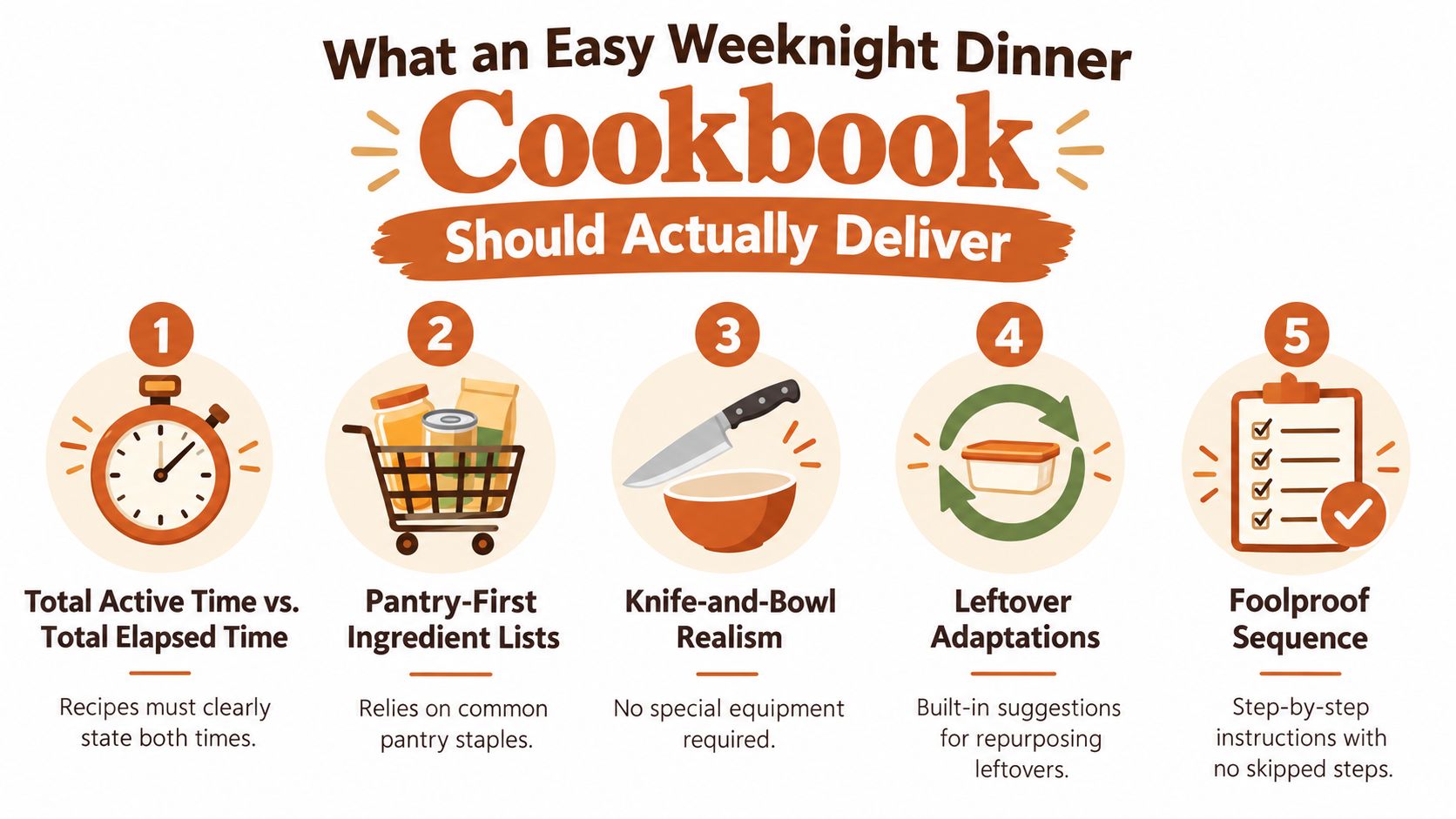
The five features that matter
- Separate active time from total time. A recipe that takes 40 minutes with 12 minutes of hands-on work is very different from one that demands constant stirring for 40 minutes. Books that blur that distinction waste your evening.
- Use pantry-first ingredient lists. The best books rely on repeat players: canned tomatoes, pasta, rice, broth, eggs, beans, onions, garlic, frozen vegetables, sturdy greens, and a short list of sauces and spices. You should be able to shop once and cook several recipes from the same book without scavenger hunting.
- Keep equipment demands small. One pot, one skillet, one sheet pan, or one appliance is the sweet spot. Anything that assumes a stand mixer, food processor, Dutch oven, and broiler-safe skillet for routine weeknight cooking is out of touch.
- Write steps in a foolproof sequence. Numbered instructions should tell you what to do in the order a normal person cooks. Not the order a food stylist thinks looks neat on the page.
- Acknowledge leftovers and cleanup. A serious weeknight book should tell you what holds for lunch, what freezes, and what pan count you're signing up for.
What counts as fluff
Here's the stuff I'd stop caring about first:
- Glossy lifestyle framing. Pretty kitchens don't cook dinner.
- Overbuilt backstories. You don't need a memoir before a skillet pasta.
- Exotic one-off ingredients. They're fine for projects, not for weekly use.
- Restaurant-style plating notes. Nobody needs microgreens at 7 p.m.
Practical rule: If a cookbook makes you feel inspired but not prepared, it's decoration.
One format that fits this practical lens is the Make-Ahead Freezer Meal Cookbook | Digital PDF, which is described as a collection of 75 make-ahead freezer meal recipes with portioning, packaging, and thawing guidance, plus recipes developed specifically for freezing and reheating. That kind of structure matters because it solves a real weeknight problem: some dinners need to be cooked tonight, and others need to be rescued from last Sunday's planning.
Recipe Structure That Holds Up Under Time Pressure
The biggest quality difference between a cookbook you use once and a cookbook you keep using is recipe architecture. Good structure removes hesitation. Bad structure creates it.
Time labels need to be honest
Recipe reliability is technical, not cosmetic. Guidance from this recipe testing methodology reference stresses measuring prep, cook, and total time in a real home kitchen, using a normal domestic pace, and making sure stated total time matches prep plus cook time. That standard matters on weeknights because small timing errors can break the evening. The same guidance also supports marking which steps are hands-on, which are passive, and which can happen at the same time.
That's exactly what a dependable easy weeknight dinner cookbook should do. I want to know whether I'm stirring, chopping, and flipping the whole time, or whether I can load a tray, wash the board, and help with homework while the oven finishes the job.
Ingredient order and equipment assumptions matter
Good recipes also respect the way real cooks move through a kitchen. Ingredient lists should follow order of use. Measurements should sound like grocery life, not a lab bench. “One 15-ounce can” is better than weirdly converted cup measures for canned beans.
Equipment needs should be explicit. If the recipe only works in a large skillet, say that. If crowding the sheet pan will steam the vegetables instead of roasting them, say that too.
| Structure Element | What to Look For |
|---|---|
| Time block | Prep, active cook, passive cook, and total time listed separately |
| Ingredient list | Ordered by use, practical package-based measurements, common substitutions |
| Equipment note | Pan size, pot size, appliance assumptions, and whether special tools are optional |
| Method flow | Numbered steps that combine tasks logically instead of scattering them |
| Yield guidance | Clear serving size and whether leftovers hold well |
| Flex notes | Make-ahead, freezer, and substitution notes that don't break the recipe |
The strongest weeknight recipes reduce mental traffic
Here's what I trust most under pressure:
- Batch-friendly prep. Chop everything for a tray bake in one pass.
- Concurrent actions. Start rice, then build the skillet dish while it cooks.
- Low-friction finishes. Lemon, herbs, yogurt, grated cheese, chili crisp, or toasted nuts added at the end.
- Built-in flexibility. Spinach for kale. Chicken thighs for breasts. White beans for chickpeas.
A weeknight recipe should feel like a stable routine, not a test of improvisation skills.
Digital vs Print Cookbooks for Busy Weeknights
The print-versus-digital argument gets silly fast because people turn it into a personality statement. For weeknight cooking, it's simpler than that. Use the format that gets dinner made with less friction.
Print wins on permanence
A printed cookbook has obvious strengths. It doesn't need charging. It doesn't dim. It doesn't lock while your fingers are oily. You can leave it open on the same page for years and trust it to stay there.
That matters if you cook from the same recipes repeatedly and hate screen juggling.
Digital wins on speed and filtering
Digital cookbooks are better when decision fatigue is the enemy. Search is faster than flipping. Zoom helps on small counters and tired eyes. Hyperlinks make jumping between a base recipe, a sauce, and a variation much less annoying.
For busy households, digital also changes planning behavior. You can browse on a laptop, shop from a phone, then cook from a tablet. If you like practical kitchen reading in that format, this healthy eating magazine guide for 2026 gives a related example of how digital food content can be used more like a reference shelf than a static object.
| Feature | Print Cookbook | Digital e-Book |
|---|---|---|
| Searchability | Slow unless you know the book well | Fast keyword search |
| Splatter tolerance | Good, especially with worn pages | Depends on device and stand |
| Battery needs | None | Yes |
| Text size | Fixed | Adjustable on many devices |
| Corrections and updates | Not usually possible after printing | Can be revised and re-downloaded |
| Portability | One physical book at a time | Same file can be used across devices |
| Planning workflow | Better for leisurely browsing | Better for filtering by time or ingredient |
| Counter use | Stable once opened | Great with a stand, annoying in hand |
If you cook by instinct and repeat favorites, print still works well. If you cook by search term and available minutes, digital is usually faster.
Sample Recipes From a Well-Designed Weeknight Cookbook
The easiest way to judge a weeknight cookbook is to imagine cooking from it when you're already tired. Not reading it. Cooking from it.
Sheet pan chicken and vegetables
A strong chapter labeled by time should let you go straight to something like a sheet pan chicken thigh dinner. The recipe header should tell you total time, active time, pan size, yield, and whether the vegetables can be swapped. Good swaps would include carrots for sweet potatoes, broccoli for green beans, or sausage for chicken.
The method should read like movement: heat oven, line pan, cut vegetables, season all on tray, roast, flip once if needed, finish with lemon or yogurt sauce. No mystery bowl count. No side quest.
Pantry pasta that doesn't pretend
A pantry pasta is where weak books get exposed. A good one uses things you likely keep around: garlic, olive oil, anchovies if you like them, chili flakes, canned crushed tomatoes, pasta, parsley, Parmesan. A realistic recipe will say whether the pasta water matters, when to reserve it, and how thick the sauce should look before tossing.
This is also where chapter design matters. In a digital cookbook, a “20-minute” or “pantry staples” filter saves you from scrolling through braises and bakes when you need dinner now. If you like that kind of low-friction format, these one-skillet dinner recipes show the same principle in a narrower category.
One-pot lentil soup built for tomorrow
Soup is one of the smartest weeknight categories because it often improves overnight. A useful recipe should flag that upfront. If it thickens in the fridge, the note should tell you to loosen it with water or broth. If greens can be stirred in at the end, the recipe should say which ones wilt quickly and which need more simmering.
A good cookbook tells you whether this serves tonight plus lunch, or whether you should double it.
The smartest weeknight recipes don't just feed tonight. They protect tomorrow.
Stir-fry with real timing
Stir-fry sounds quick because it is quick once everything is prepped. That's the trap. The recipe has to respect mise en place without turning it into culinary homework.
A good version states that rice should start first if you're serving it. Then it gives a short sauce formula, a protein option, a vegetable range, and a cooking sequence that keeps the pan hot and the food from steaming. If a cookbook nails stir-fry timing, it usually understands weeknights.
A Simple Meal-Planning System Built Around Your Cookbook
Don't need a complicated meal-planning spreadsheet. They need a repeatable weekly routine that makes 6 p.m. less chaotic.
This works well because it treats your cookbook like a scheduling tool.
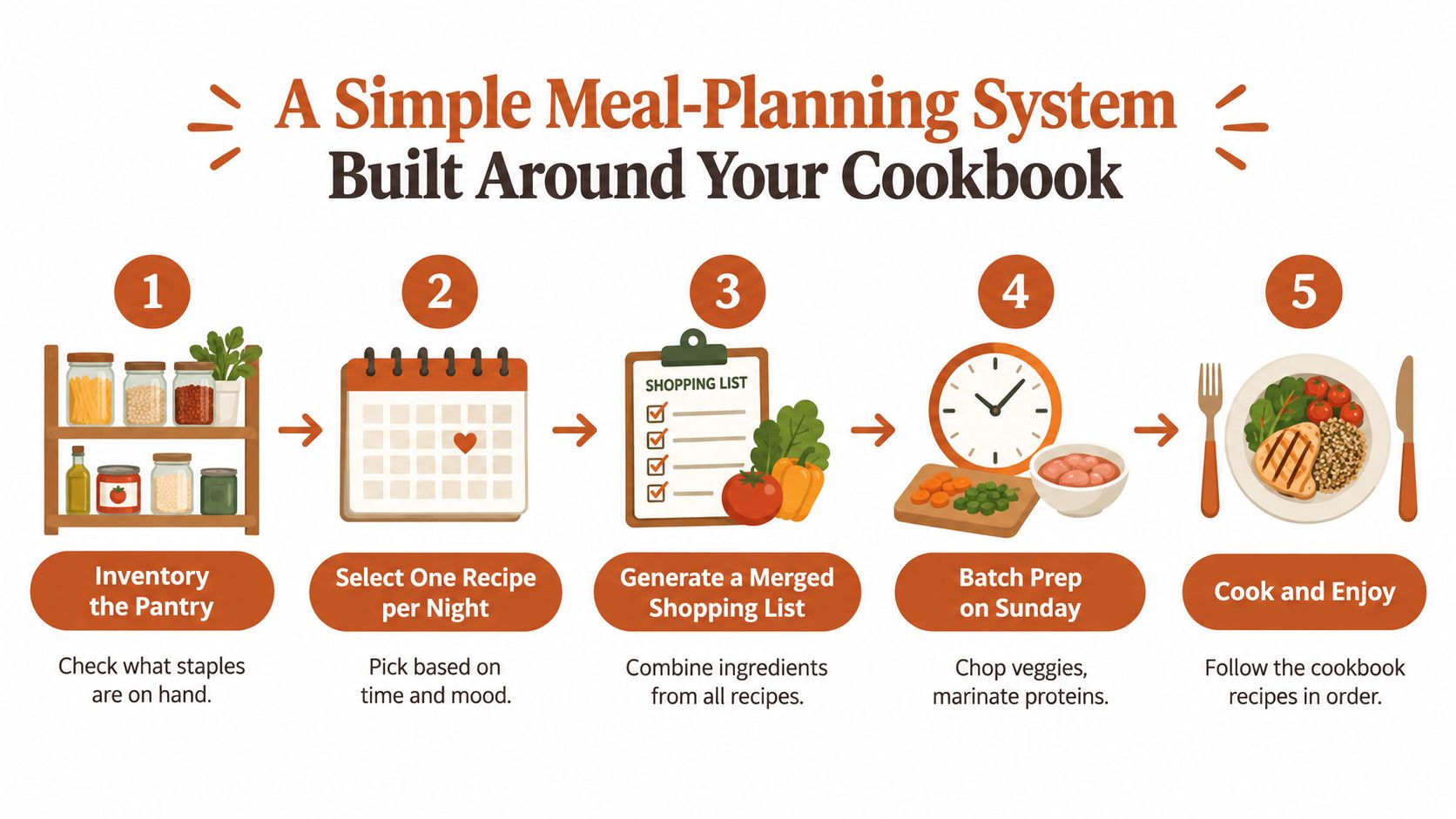
The five-step system
-
Check the pantry first
Start with rice, pasta, canned beans, tomatoes, broth, eggs, onions, garlic, frozen vegetables, and any proteins already in the fridge or freezer. -
Pick one dinner per night by available time
Monday might be 20 minutes. Wednesday might tolerate 45 if most of it is oven time. Friday might need leftovers, breakfast-for-dinner, or a freezer meal. -
Merge the shopping list
Don't shop recipe by recipe. Shop for overlap. If three meals use onions, lemons, spinach, or yogurt, buy once with a plan.
A short visual helps here if you want a simple model to follow.
-
Batch the annoying prep once
Cook rice. Wash greens. chop onions. Mix one sauce base. Marinate one protein. Small prep done ahead removes friction all week. -
Protect one low-effort night
Leave room for leftovers, sandwiches, soup from the freezer, or a no-cook plate. That cushion keeps the whole system from collapsing.
A realistic Monday to Friday example
- Monday: Sheet pan chicken and vegetables
- Tuesday: Pantry pasta with salad
- Wednesday: Lentil soup with bread
- Thursday: Stir-fry using remaining vegetables and rice
- Friday: Leftovers or a freezer dinner
That's enough structure to stop the nightly scramble without turning dinner into project management. If you want more ideas built around that same logic, these meal prep dinners for the week fit neatly into this kind of plan.
How Just Cook It e-Books Fit the Weeknight Cook
If you read all of this and thought, “Fine, but where do I find cookbooks built like that,” digital-first publishing has a real advantage.
Just Cook It's format lines up with the practical needs that matter on weeknights. The publisher offers instant-download digital cookbook e-books, compatible with phone, tablet, laptop, and e-reader devices, with lifetime access and free updates. For a tired cook, that means the file can move from Sunday planning on a larger screen to Tuesday cooking on a phone propped near the stove.
Why the format suits weeknight cooking
The useful part isn't that the books are digital by itself. It's what digital can support when the cookbook is built well.
- Search and filtering help you choose by constraint. Quick-dinner collections and category filters like Quick Dinners and Healthy Eating make more sense for weeknight use than wandering through a general table of contents.
- Kitchen-tested recipes matter more than novelty. Just Cook It states that every recipe is developed and re-tested in a standard home kitchen until reliable, with concise steps and practical tips that affect outcomes.
- Everyday ingredients keep the book in rotation. The publisher emphasizes widely available ingredients and no specialized equipment required. That's exactly what repeat-use weeknight books need.
- Lifetime updates are more useful in digital than in print. If a recipe method is clarified or improved, the format allows re-downloads without replacing the whole book.
The catalog makes more sense as a reusable tool than a collectible
This is the right way to think about it. A weeknight cookbook shouldn't be judged only by how fun it is to browse. Judge it by whether it becomes part of your weekly operating system.
Just Cook It also publishes across global cuisines, which matters because “easy” shouldn't mean boring. That lines up with a broader market gap. Trend analysis summarized by Accio's cookbook trends overview suggests interest is shifting toward more specific use cases such as healthy, vegetarian, and international cooking, rather than one generic easy-dinner bucket. In plain terms, people still want speed, but they also want food that fits how they eat.
There's another practical point. A 2026 roundup discussed in Let's Foodie's weeknight cookbook article notes that strong weeknight titles lean on short ingredient lists, one-pan cleanup, and realistic prep times over showy technique. That's the standard I'd use here too.
If you want an easy weeknight dinner cookbook that earns its keep, look for books that reduce decisions, state time, assume a normal kitchen, and don't punish you with cleanup. That's not a small preference. It's the whole job.
If you want cookbooks that behave more like practical weeknight tools than coffee-table objects, Just Cook It offers downloadable e-books built for everyday home cooking, with kitchen-tested recipes, device-friendly reading, and lifetime updates. If your biggest dinner problem is decision fatigue, start with a quick-dinner or pantry-friendly collection and use it the way you'd use a planner: pick by time, cook with confidence, repeat next week.